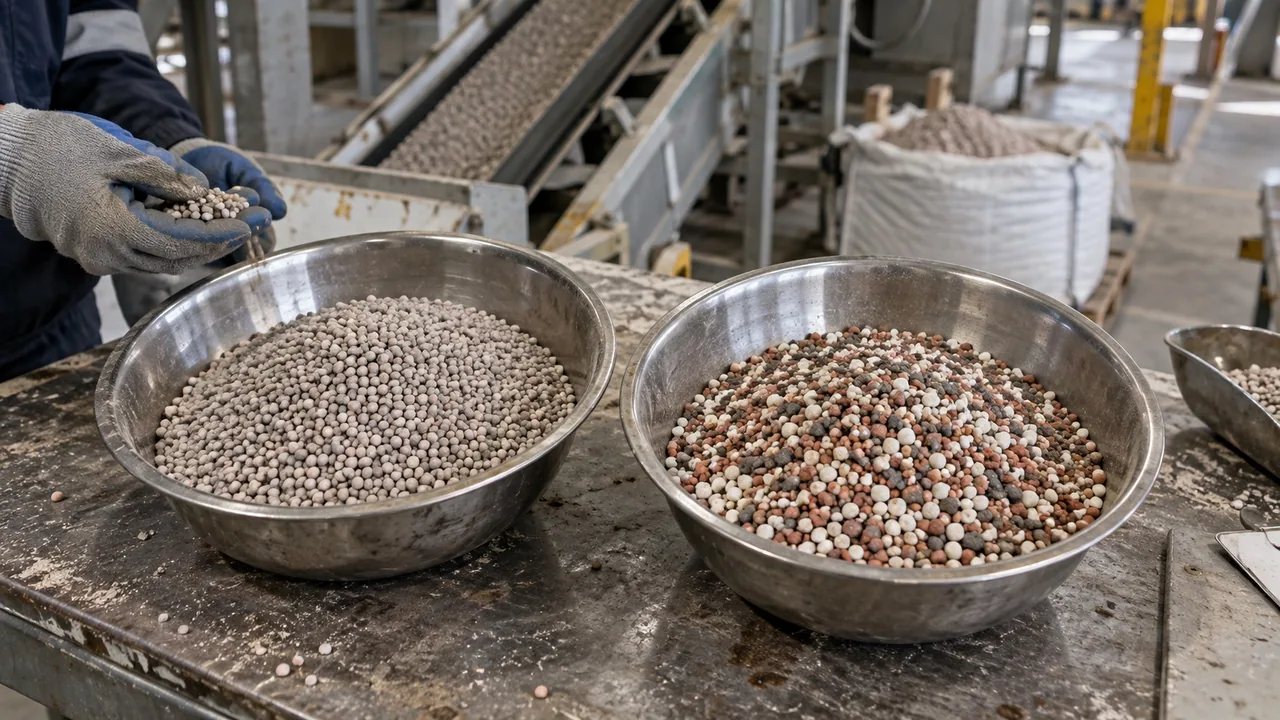
A bag marked 15-15-15 may be a compound fertilizer or a physical bulk blend. The grade alone does not explain how nutrients are distributed, which raw materials were used, how the product handles, or whether it will spread uniformly.
For an importer, the first decision is not which process sounds more advanced. It is which product structure fits the crop programme, equipment, local market, logistics and regulatory requirement.
Quick comparison
| Factor | Compound or complex NPK | Bulk blended fertilizer |
|---|---|---|
| Product structure | Multiple nutrients are generally combined within each granule | Separate fertilizer materials are physically mixed |
| Appearance | Often more uniform | Components may differ in colour, size and density |
| Segregation risk | Usually lower within an intact product | Depends heavily on physical compatibility and handling |
| Formula flexibility | Production campaigns and minimum quantities may constrain customization | Often easier to adjust by changing blend proportions |
| Inspection focus | Nutrient content, granule quality and production consistency | Component identity, blend uniformity and segregation risk |
| Logistics | Finished product moves as one grade | May be blended near consumption to reduce transport segregation |
Neither type is automatically superior. A well-designed bulk blend can be commercially effective; a poorly controlled compound product can still fail specification.
What “compound” means in purchasing practice
FAO classifies compound or complex fertilizers as products containing at least two of the major nutrients. In a chemically produced or granulated NPK, the target nutrients are generally incorporated within each granule to a defined degree.
This can support more uniform nutrient distribution during spreading, provided the granules remain intact and the product meets its specification. The buyer should still confirm:
- grade and nutrient forms;
- water-soluble or available nutrient basis where applicable;
- chloride level or chloride declaration;
- secondary and micronutrient content;
- granule size distribution;
- moisture, strength and caking behaviour;
- coating or conditioning agents;
- contaminant limits;
- production standard and test methods.
What “bulk blend” means
A bulk blend is made by physically mixing separate fertilizer materials. One granule may be urea, another may be DAP or MOP, and the guaranteed grade describes the mixture as a whole.
The process allows formula flexibility, but it introduces a physical-design problem. Components with different size, density or shape can separate while being conveyed, transported, discharged or spread. The mixture sampled at one point may not match the mixture delivered elsewhere.
A buyer should review:
- identity and specification of every component;
- calculated formulation and nutrient contribution;
- particle-size compatibility;
- density and shape differences;
- mixing method and batch controls;
- blend uniformity testing;
- expected handling and transport route;
- rehandling points before application.
Nutrient grade is only the starting point
The sequence N-P2O5-K2O expresses guaranteed nutrient percentages by weight. It does not explain nutrient source, solubility, release pattern or agronomic suitability.
Two 15-15-15 products may use different nitrogen forms, phosphate sources or potassium sources. They may differ in chloride, sulphur, micronutrients and physical behaviour. Buyers should have the formula reviewed by the appropriate agronomic and regulatory teams rather than treating the grade as a complete specification.
When compound NPK may be preferred
Compound NPK may fit buyers who need:
- a relatively uniform multi-nutrient granule;
- reduced segregation risk during long transport and repeated handling;
- a standardized retail or distributor product;
- defined granule size for mechanical spreading;
- a repeatable formula across scheduled shipments.
Tradeoffs can include production minimums, longer lead time, lower formula flexibility and additional cost for specific processes or coatings.
When bulk blend may be preferred
Bulk blending may fit buyers who need:
- formula flexibility for local soils or crops;
- adjustment between seasons;
- access to locally available straight fertilizers;
- blending close to final use;
- a commercial structure where component procurement is more efficient.
It is less attractive when components have poor physical compatibility, the product will undergo long transport with repeated vibration, or the buyer lacks effective blending and quality controls.
Physical quality and segregation
Segregation can occur when smaller or denser particles move through gaps while larger or lighter particles remain elsewhere. Repeated transfer points increase the opportunity for separation.
To assess the risk, compare:
- sieve distributions, not only average size;
- bulk density;
- granule shape and surface;
- particle strength and fines generation;
- storage and transport time;
- number of loading, discharge and transfer operations;
- spreader calibration and field practice.
A visual inspection may detect obvious separation, but it cannot establish nutrient uniformity across an entire consignment.
Inspection plans should differ
For compound NPK, inspection may focus on lot identification, nutrient analysis, moisture, size, strength, fines, caking, packing and loading condition.
For a bulk blend, the plan should also address component identity, formulation records, mixer controls, distribution across the batch and the points where samples are taken. A composite sample can hide local segregation if the sampling design is poor.
Agree the method before production or loading. Define:
- lot and batch boundaries;
- number and location of increments;
- sample reduction and sealing;
- laboratory and test methods;
- tolerance and rounding rules;
- action for non-conforming or non-uniform results.
Packing and marking
The label should match the exact product and destination requirements. Buyers may need to define:
- guaranteed analysis and nutrient forms;
- net weight;
- intended use and directions where required;
- batch identification;
- manufacturer, registrant or importer details;
- warnings and storage instructions;
- required language and measurement units;
- registration, conformity or traceability information.
Destination rules vary. For example, EU fertilising products placed on the market under Regulation (EU) 2019/1009 must follow the applicable product, conformity and labelling route. Canada has separate federal registration, safety and labelling rules. Confirm the applicable regime before artwork approval.
Questions to put in the RFQ
- Is the product compound, complex, granulated or bulk blended?
- What are the nutrient sources and declared nutrient forms?
- What is the full guaranteed analysis?
- What particle-size distribution and physical tolerances apply?
- For a blend, what are the component specifications and mixing controls?
- What lot and sampling definitions will be used?
- What packing and destination label are required?
- Which tests and documents are included?
- What production and shipment lead time is realistic?
- Which legal entity manufactures, sells, exports and receives payment?
Common purchasing errors
- comparing products only by NPK grade and price;
- assuming every granule in a blend contains every nutrient;
- using colour as evidence of nutrient content;
- ignoring chloride, nutrient form or solubility;
- failing to compare component particle sizes;
- sampling a segregated blend from one convenient point;
- approving labels before the destination classification is confirmed;
- accepting “custom formula” without a written formulation and tolerance.
Procurement decision
Choose the structure that best controls the buyer’s actual risk. For a long international route and standardized distribution product, compound NPK may offer operational advantages. For locally optimized formulas and short handling routes, a controlled bulk blend may be more flexible.
FertiAxis China can help a qualified buyer clarify the requirement and assess potential Chinese supply routes. Start with company, product, quantity and destination, then provide the grade, nutrient forms, physical specification, packing and shipment basis.
Important boundary
This guide does not recommend a fertilizer formula or application rate. Agronomic suitability, destination registration, label approval and batch acceptance require transaction-specific review by the relevant professionals.
Reference sources
- Fertilizer specifications — Food and Agriculture Organization of the United Nations ↗
- Fertilizer procurement — Food and Agriculture Organization of the United Nations ↗
- Regulation (EU) 2019/1009 on EU fertilising products — EUR-Lex ↗
- Fertilizer labelling requirements — Canadian Food Inspection Agency ↗
Last editorial review: 9 September 2026. Time-sensitive requirements should be reconfirmed for the specific destination and transaction.