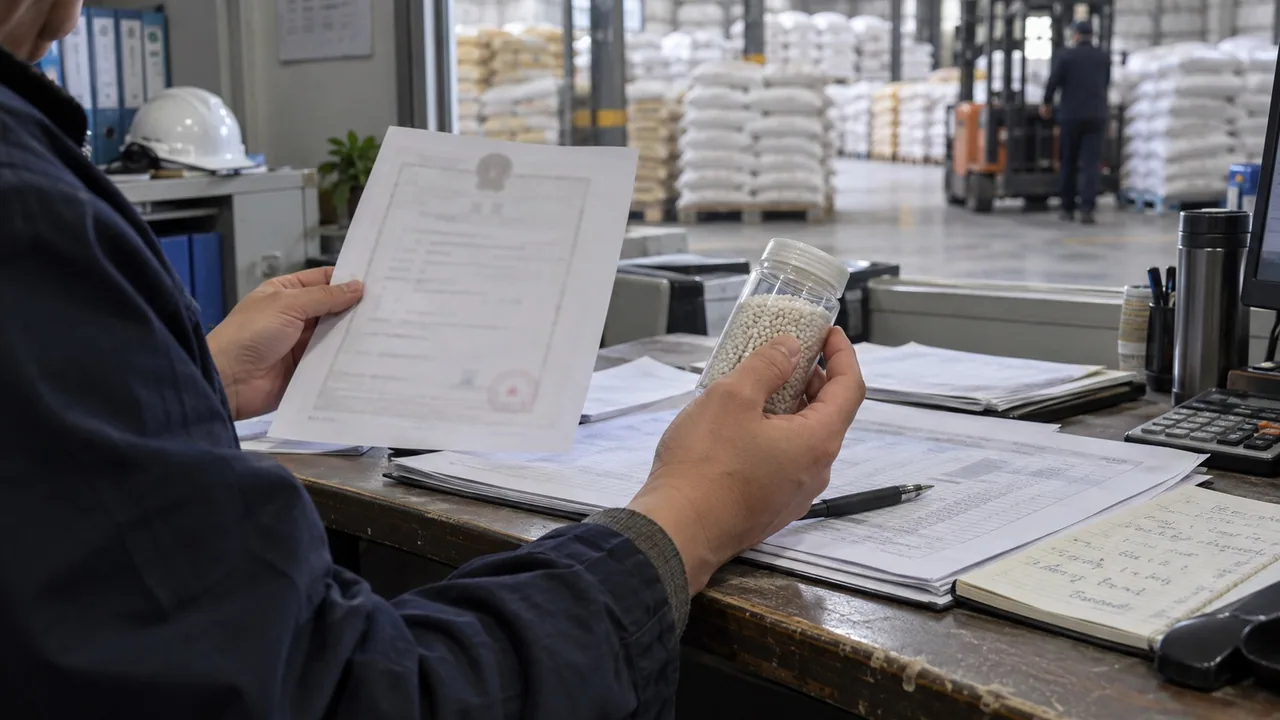
Screening a Chinese fertilizer supplier is not a single database search and should not end when a business licence is found. A legally registered company may still be acting outside its normal product capability, relying on another exporter, presenting historical documents, or offering goods it does not control.
For an overseas importer or distributor, the practical objective is not to obtain a vague “verified supplier” label. It is to understand who the counterparty is, what role it will perform, what evidence supports the proposed product and shipment, and which risks remain unresolved before contract or payment.
This guide presents a buyer-side screening framework for Chinese fertilizer manufacturers, affiliated sales companies, exporters and independent traders. It is intended for defined commercial requirements rather than retail purchases or general requests for the lowest price.
What supplier screening should establish
A useful review should answer several separate questions:
- Does the company legally exist and remain active?
- Is the company that issued the offer the same entity expected to sign the contract and receive payment?
- Is it a manufacturer, an exporter, a trader or another intermediary?
- Can it support the required fertilizer specification, packing and volume?
- Does it have a credible route for export documentation and shipment execution?
- Are the bank account, contract, invoice and product documents consistent with the same transaction structure?
- What still requires independent inspection, legal review, sanctions screening, credit review or payment protection?
These questions must be kept separate. A company registration record does not prove stock. A factory video does not prove ownership of the goods. A certificate does not prove that the offered batch will conform. An export history does not guarantee future performance.
1. Confirm the exact Chinese legal entity
Start with the supplier’s full legal name in Chinese and its Unified Social Credit Code. English trading names are useful for communication but are not sufficient for a reliable company search because translations and abbreviations vary.
Compare the supplied business licence with information available through China’s National Enterprise Credit Information Publicity System. Relevant fields may include:
- current registration status;
- legal representative;
- registered address;
- establishment date;
- registered capital;
- stated business scope;
- shareholders or filed changes where available;
- administrative penalties, abnormal-operation entries or serious legal violations shown in the system.
The objective is consistency, not the appearance of a large registered-capital figure. Confirm that the legal name and credit code match across the business licence, proposed contract, invoice and bank documentation.
Registration confirms the identity and recorded status of an entity. It does not independently prove that the company manufactures fertilizer, controls inventory, has export capacity or can perform the proposed transaction.
2. Identify the supplier’s actual commercial role
Chinese fertilizer offers may come from several types of counterparties:
- the producing factory;
- a sales company within the same corporate group;
- an export company connected to the producer;
- an independent fertilizer trader;
- a general trading company buying from another source;
- an intermediary that does not intend to sign the contract.
None of these structures is automatically unacceptable. The risk comes from an unexplained or misrepresented role.
Ask the counterparty to explain:
- which legal entity operates the production site;
- which entity will issue the commercial offer;
- which entity will sign the sales contract;
- which entity will receive payment;
- which entity will appear on export and shipping documents;
- how the seller is connected to the stated producer;
- whether another party controls the product allocation or export route.
If the contracting seller is not the manufacturer, request evidence that explains the relationship. Depending on the proposed structure, this may include an authorization, group-company information, a supply agreement excerpt, historical transaction evidence or direct confirmation from the producer. The evidence required should be proportionate to the value and risk of the transaction.
3. Check whether the product fits the company’s normal capability
A supplier may be genuine but unsuitable for the specific requirement. Screening therefore needs to test product fit, not only company identity.
For a defined fertilizer requirement, compare the offer against:
- product name and intended use;
- nutrient or chemical specification;
- granular, prilled, crystalline, powder or liquid form;
- moisture, particle-size, impurity and physical-condition limits where relevant;
- bag size, construction, marking and pallet requirements;
- requested quantity and shipment frequency;
- destination-market registration or documentation requirements;
- inspection and testing expectations;
- target loading and arrival windows.
For example, an overseas buyer sourcing urea should not accept an offer that states only “46% urea.” The requirement may also need to distinguish granular from prilled material, agricultural from technical use, particle-size expectations, biuret limits, packing and the applicable product standard.
Similarly, an ammonium sulphate enquiry should define crystal or granular form, nitrogen and sulphur basis, production route where relevant, colour or physical requirements, packing and inspection conditions.
Useful capability evidence may include technical data sheets, recent but appropriately redacted certificates of analysis, packing specifications, production or loading records, and an explanation of normal production or trading volumes. Historical evidence should be clearly treated as historical; it is not evidence that a current batch exists.
4. Test document consistency rather than collecting documents
Fraud prevention is not improved simply by requesting a large document package. Each document should answer a defined question and should be checked against the rest of the proposed transaction.
Review whether the following information is consistent:
- legal company name;
- company address and contact details;
- product description and specification;
- producer and seller relationship;
- contracting party;
- bank beneficiary;
- quantity and packing;
- ports and Incoterm;
- document issuer;
- dates, reference numbers and shipment details.
Documents should also be classified correctly:
- Corporate document: identifies or describes a company.
- Management-system certificate: relates to a management system and its stated scope.
- Product document: describes a product or test result.
- Batch or shipment document: relates to identified goods or a specific movement.
- Third-party document: issued or endorsed by an independent inspection, testing, logistics, customs or government body.
An ISO 9001 certificate, even when authentic and within scope, is not a product certificate and does not guarantee the quality of a future fertilizer shipment. Buyers should confirm the issuing certification body, certificate scope, covered site and validity, then decide what separate product and shipment controls are still required.
5. Review export and customs readiness
The seller must have a workable route for export execution. This does not always mean the factory itself must be the exporter, but the parties involved must be identified before contracting.
Ask who will be responsible for:
- export declaration;
- commercial invoice and packing list;
- certificate of origin where required;
- product-specific certificates or declarations;
- inspection or weight documentation;
- booking and inland transport;
- bill of lading instructions;
- compliance with current Chinese export controls and destination requirements.
China Customs maintains enterprise administration and registration systems for parties involved in import and export activities. However, a customs record should be treated as one part of the review. It does not establish that the entity currently has access to the offered fertilizer or that the proposed shipment is permitted under the rules applicable on the transaction date.
Export policies, inspection rules, tax treatment and documentation requirements can change. They should be reconfirmed for the product, origin, destination and planned shipment window before the parties rely on a quotation.
6. Verify the production or loading location when risk justifies it
Remote screening can identify inconsistencies, but it cannot replace every physical check. For higher-value or unfamiliar transactions, buyers should consider an appropriate site, production, stock or loading verification.
A useful verification scope may include:
- confirming the physical address and facility operator;
- identifying whether the site is a factory, warehouse or office;
- checking that the observed equipment and process are relevant to the product;
- confirming packing capability and markings;
- reviewing quality-control procedures and laboratory arrangements;
- identifying the proposed loading point;
- recording what was and was not physically observed.
Live video can support preliminary communication, but it is easier to stage and should not be treated as equivalent to an independent site visit. A visit also needs a written scope: “factory visited” is not the same as confirming available stock, testing a batch or supervising loading.
7. Build the quality and inspection plan before payment
Supplier screening and product inspection serve different purposes. Screening assesses the counterparty and proposed execution route. Inspection assesses defined product, packing, quantity or loading conditions at an agreed stage.
Before contracting, the buyer should define:
- specification and test methods;
- sampling method;
- acceptable tolerances;
- inspection company or laboratory, if independent testing is required;
- inspection timing;
- who appoints and pays the inspector;
- what happens if results do not conform;
- which document or result releases payment or shipment.
A certificate of analysis supplied before production may be useful for technical discussion, but it cannot establish the conformity of goods that have not yet been sampled. Where the transaction risk justifies it, inspection conditions should connect the contract, identified goods, sampling, testing and payment sequence.
8. Define the commercial and logistics structure precisely
A supplier comparison is unreliable when offers use different delivery assumptions. State the Incoterm, named port or place and rule version—for example, CFR Mombasa, Incoterms® 2020—rather than asking only for a “CIF price” or “FOB China.”
The buyer requirement checklist should be completed before final supplier comparison. At minimum, define:
- quantity and acceptable tolerance;
- containerized or bulk shipment;
- loading and destination ports;
- shipment window;
- trans-shipment restrictions;
- required documents;
- payment instrument and milestones;
- responsibility for inspection;
- the point at which risk transfers.
The International Chamber of Commerce recommends identifying the chosen Incoterms® rule, precise named port, place or point, and the 2020 version in the contract. Remember that cost allocation, delivery and transfer of risk are not always the same event.
9. Screen sanctions, restricted-party and destination risk
Sanctions and restricted-party checks must reflect the buyer’s jurisdiction, banks, currency, vessels, insurers, destination, product and other parties involved. A single name search is not a complete compliance process.
At a preliminary stage, compare relevant legal entity names, aliases and ownership information against applicable official lists. The U.S. Office of Foreign Assets Control provides a sanctions search tool, and the United Nations Security Council publishes a consolidated list. Other national or regional regimes may also apply.
Potential matches require careful identification; similar names do not automatically mean the company is sanctioned. Conversely, a clean name search does not resolve ownership, control, end-use or destination restrictions. Obtain specialist advice when the transaction presents elevated compliance risk.
10. Check contract and payment alignment
One of the clearest warning signs is a mismatch between the seller and the requested payment beneficiary.
Before payment, confirm:
- the contract identifies the same legal entity that was screened;
- the beneficiary name matches the agreed contracting and payment structure;
- any third-party payment arrangement has a documented commercial and legal explanation;
- bank-detail changes are independently reconfirmed through a known communication channel;
- product, quantity, specification, price and delivery terms match the approved offer;
- inspection and document conditions are operationally achievable;
- dispute, governing-law and performance provisions have been reviewed at the appropriate level.
Do not rely on email alone for a last-minute bank-account change. Compromised business email and substituted payment instructions are material risks in international trade.
Common warning signs in fertilizer offers
No single warning sign proves fraud, but several unexplained inconsistencies should stop the transaction until resolved.
| Warning sign | Why it matters | Practical response |
|---|---|---|
| The seller provides only an English company name | The legal entity may not be identifiable | Request the Chinese legal name and Unified Social Credit Code |
| The factory, seller, exporter and beneficiary are different companies | The transaction structure and responsibility may be unclear | Map every entity and require written evidence of each relationship |
| The offer is materially below comparable market indications | The product, terms, quantity or availability may not be comparable | Recheck the full specification and execution basis |
| Certificates contain different company names or addresses | Documents may relate to another site, entity or historical transaction | Verify the issuer, scope, dates and connection to the proposed seller |
| The supplier refuses a defined inspection process | Product or loading conditions cannot be independently tested | Do not proceed until inspection rights and consequences are agreed |
| Payment is requested to a personal or unrelated account | Funds may not reach the contracting seller | Stop and independently verify the proposed payment structure |
| “Available stock” cannot be connected to an identified location or holder | Images and documents may not prove control of goods | Define and independently verify the stock-check scope |
| Urgency is used to prevent review | Time pressure increases the chance of missed inconsistencies | Keep approval, verification and payment controls in place |
A practical supplier screening sequence
For a new Chinese fertilizer counterparty, a proportionate sequence is:
- Define the buyer requirement.
- Obtain the Chinese legal name and credit code.
- Check company registration and recorded status.
- Map the producer, seller, exporter and payment beneficiary.
- Review product and packing capability.
- Check document consistency and issuing parties.
- Confirm the proposed export and logistics route.
- Run applicable sanctions and compliance checks.
- Define inspection, testing and payment controls.
- Resolve material discrepancies before introduction, contracting or payment.
The depth of review should increase with transaction value, payment exposure, product risk, unfamiliarity and complexity. A trial order may reduce volume exposure, but it does not remove the need to identify the counterparty and protect payment.
What a broker’s initial screening can and cannot do
A structured supplier matching and brokerage service can help a buyer identify potential counterparties, clarify commercial roles, compare evidence and document unresolved questions. A China-based contact can also support Chinese-language communication and local context during this process.
Initial screening cannot guarantee:
- ownership or availability of future goods;
- conformity of an untested batch;
- financial capacity or future solvency;
- authority that has not been independently established;
- compliance with every law applicable to the buyer;
- shipment, payment or contract performance.
The appropriate result is not a universal “verified” badge. It is a documented review showing what was checked, what evidence was considered, what limitations apply and what actions remain before the buyer commits funds.
If your company has a defined fertilizer requirement, review our service and buyer qualification process or contact FertiAxis China first with your company, product, quantity and destination.
Important boundary
This article provides general commercial information, not legal, regulatory, sanctions, credit, inspection or financial advice. Screening scope should be agreed in writing. Requirements and official records must be checked against current sources for the specific entities, product, destination and transaction date.
Reference sources
- National Enterprise Credit Information Publicity System — SAMR ↗
- Enterprise Administration Service Guide — General Administration of Customs of China ↗
- Sanctions List Search Tool — U.S. Office of Foreign Assets Control ↗
- United Nations Security Council Consolidated List ↗
- How Can You Have Confidence That Your Supplier Meets ISO 9001? — ISO ↗
- Incoterms® 2020 Q&A — International Chamber of Commerce ↗
Last editorial review: 6 September 2026. Time-sensitive requirements should be reconfirmed for the specific destination and transaction.