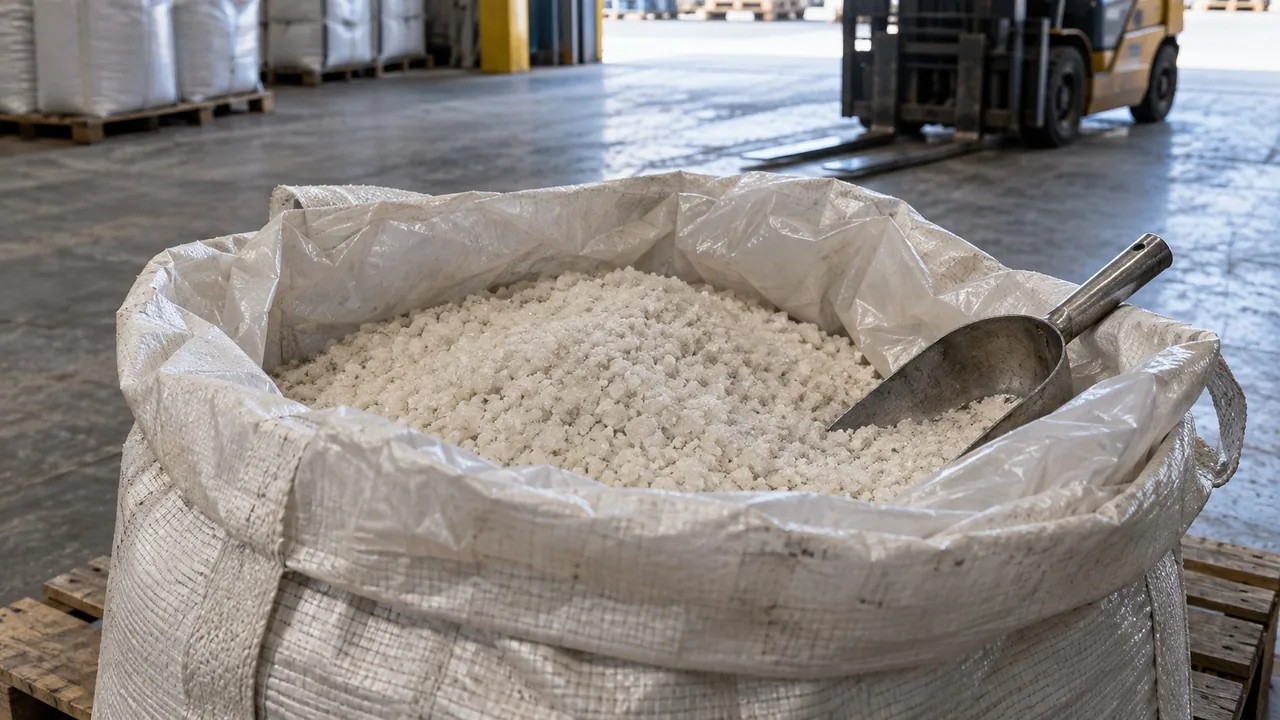
Ammonium sulphate is a nitrogen and sulphur fertilizer used for direct application and as a component in fertilizer mixtures. A buyer still needs to define more than “21% nitrogen.” Crystal form, granular form, sulphur reporting basis, production route, impurities, particle size, packing and destination compliance can materially change whether an offer is suitable.
What is ammonium sulphate?
FAO describes ammonium sulphate as a highly water-soluble fertilizer providing approximately 21% nitrogen in ammonium form and 23–24% sulphur in sulphate form. It is used directly or as an ingredient in fertilizer mixtures.
Those general values do not automatically define the sale contract. The guaranteed analysis may express sulphur as elemental S or as sulphur trioxide SO3. Buyers must state which basis applies. Comparing 24% S with 24% SO3 would be a serious error because they are not equivalent declarations.
Crystal vs granular ammonium sulphate
| Buying factor | Crystalline product | Granular product |
|---|---|---|
| Physical form | Smaller crystals or crystalline particles | Larger agglomerated or compacted granules |
| Direct spreading | Depends on local equipment and particle distribution | Often selected for wider mechanical spreading |
| Blending | Must be assessed against other component sizes | May offer better size compatibility with granular blends |
| Handling | Fines, dust and caking need control | Granule strength and breakdown need control |
| Price | Often different production and logistics basis | Added processing may affect cost |
The product name is not enough. Request the actual sieve distribution, bulk density and handling data. Granulation does not guarantee strong particles; crystalline material is not automatically low quality.
Understand the production route
Ammonium sulphate may be produced through different industrial routes, including as a primary chemical product or as a co-product from another process. The route can influence colour, particle form, impurity profile, trace substances and consistency.
A buyer should ask:
- which legal entity produces the material;
- what production route is used;
- whether the quoted seller is the producer or a trader;
- what process controls and testing apply;
- which impurities or contaminants are routinely monitored;
- whether the product has a stable, repeatable specification;
- whether the intended destination accepts the composition and source.
Do not reject a product only because it is grey, off-white or slightly coloured. Do not accept it only because it is bright white. Colour can be commercially relevant, but it is not a substitute for chemical and physical testing.
Build the technical specification
A practical requirement should state:
- total nitrogen minimum;
- ammoniacal nitrogen basis where required;
- sulphur as elemental S or SO3;
- free acidity limit;
- moisture limit;
- particle form and sieve distribution;
- free-flowing condition and fines limit;
- insoluble matter and any process-specific impurity limits;
- contaminant limits required by the destination;
- sampling and test methods;
- packaging, marking and weight tolerance.
If the product will enter an NPK blend, add physical-compatibility requirements. If it will be applied directly, confirm that the selected form fits spreading equipment and crop programme.
Packaging and shipment decisions
Common formats include small woven bags with inner liners and larger flexible intermediate bulk containers. The buyer should define bag weight, liner, closure, lifting loops, pallet requirement, artwork, lot identification and destination labels.
For containerized shipment, inspect:
- container dryness and cleanliness;
- floor condition and evidence of contamination;
- bag condition before loading;
- loading pattern and weight distribution;
- protection from moisture ingress;
- seal number and loading record.
For bulk carriage, cargo characterization and safe carriage requirements must be reviewed for the exact product and current shipment. Do not infer the shipping classification from another fertilizer.
Inspection and laboratory testing
The inspection plan should distinguish physical checks from chemical analysis.
Physical checks may include:
- crystal or granule form;
- sieve distribution;
- fines, lumps and caking;
- appearance against an agreed reference;
- bag construction, markings and net weight;
- lot identity, quantity and loading condition.
Laboratory checks may include:
- nitrogen and sulphur;
- moisture;
- free acidity;
- insoluble matter;
- product- or destination-specific contaminants.
The parties should agree the sampling method, laboratory, test methods, timing and consequences of non-conformity before payment. A supplier’s typical analysis can support technical discussion, but it is not a result for future or unidentified goods.
Registration and labelling at destination
Destination requirements are not uniform. The EU fertilising-products framework includes product categories, component-material rules, conformity assessment, declarations and labelling requirements for products placed on the EU market under that regime. Canada regulates fertilizers and supplements under its own federal framework; some products require pre-market registration, while regulated products must meet applicable safety and labelling requirements.
The buyer or importer should determine the correct pathway before ordering printed bags. Check:
- product classification and intended claims;
- guaranteed nutrient analysis and reporting basis;
- contaminant limits;
- manufacturer and importer identification;
- required languages and units;
- registration or conformity status;
- supporting analytical and manufacturing information;
- customs classification and import permit requirements.
FertiAxis can help coordinate supply-side information, but destination-market approval belongs with the buyer and its appointed regulatory specialists.
Documents to request
Depending on the transaction, the document matrix may include:
- commercial invoice and packing list;
- transport document;
- certificate of origin;
- certificate of analysis;
- safety data sheet;
- inspection, weight or quantity certificate;
- manufacturer declaration or technical data sheet;
- destination-specific registration or conformity documents.
Check that the product description, nutrient basis, quantity, bag count, entity names and dates are consistent across the set.
Common purchasing risks
- sulphur is reported as SO3 in one document and elemental S in another;
- crystal and granular descriptions change between offer and specification;
- colour is treated as proof of purity;
- the production route is unclear or misrepresented;
- contaminant limits are copied from the wrong destination market;
- an old certificate is presented as evidence for current goods;
- the bag artwork is approved after production instead of before;
- physical compatibility for blending is not checked;
- supplier, exporter and beneficiary relationships are not explained.
A buyer-ready enquiry
Send the supplier one consolidated requirement containing product form, nutrient basis, chemical limits, particle-size distribution, intended use, packing, quantity, destination, shipment window, Incoterm, inspection and documents.
If you are seeking a China supply route, send FertiAxis China your company, product, quantity and destination first. We proceed to supplier contact after the buyer and commercial requirement are sufficiently complete.
Important boundary
This article provides general procurement information, not agronomic, chemical-safety, legal, customs or regulatory advice. Confirm current requirements for the specific composition, claims, destination and shipment date.
Reference sources
Last editorial review: 9 September 2026. Time-sensitive requirements should be reconfirmed for the specific destination and transaction.